
Lead pages that convert paid and organic traffic
A practical framework for building landing pages that convert both paid and organic traffic without sacrificing lead quality.
The mismatch that kills conversion
Traffic source promise and hero message must say the same thing.
When users click a paid ad or organic result and land on a page with a different message, trust breaks in seconds. The page might look professional, but the conversion path is already damaged.
This is called message mismatch, and it is one of the highest-impact causes of low conversion rates. The problem is structural, not visual.
A high-converting page continues the exact promise that started in the ad, social post, or search result. Visitors should feel continuity, not confusion.
Understand the intent difference: paid vs organic visitors
Paid traffic often arrives with high urgency and low trust. Organic traffic often arrives with higher trust but mixed decision readiness. If you treat both the same, you underperform with both.
A mixed-traffic page should satisfy quick evaluators and careful evaluators in one flow: immediate clarity up top, deeper proof as users scroll.
This does not mean building two separate pages by default. It means writing one page that handles both decision speeds in a clear order.
- Paid intent: quick relevance check, low patience for ambiguity
- Organic intent: deeper comparison, more educational exploration
- Both intents: need one clear next step and believable proof
Build a source-aware message map
Treat each traffic source as a message contract. The promise made in ads, social, or search must be visible in the hero and repeated near conversion points.
When source intent and page language stay aligned, bounce rate falls and qualified form submissions usually improve.
- Paid ads: keep headline close to ad claim and urgency language
- Organic search: add practical explanation blocks for comparers
- Social traffic: reinforce credibility quickly with proof above the fold
- Brand/direct traffic: focus on speed to action and reduced friction
Conversion framework for mixed traffic
The hero should answer three questions immediately: what is this, who is it for, and what should I do next. If users need to interpret the page, you lose momentum.
Proof should not be dumped at the bottom. Put trust where decisions happen: near CTA buttons, near forms, and before commitment moments.
Use progressive disclosure. Give fast readers a clear CTA quickly, while giving careful readers enough validation to commit without leaving the page.
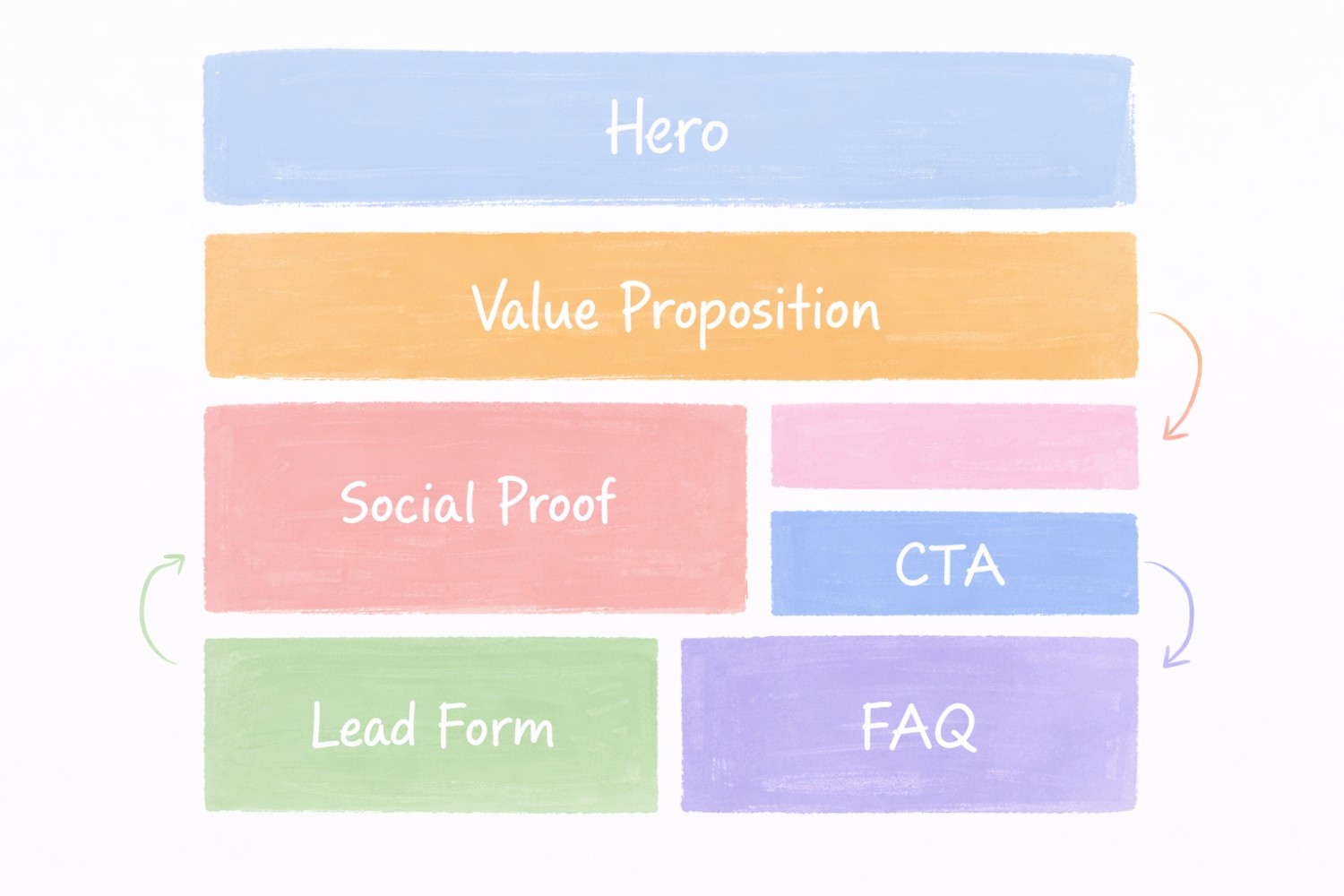
- Hero: one explicit outcome and one CTA
- Proof: one trust layer near hero and one before form
- Friction: ask for minimum data first, enrich later
- Reassurance: remove hidden risk with guarantees or clear process
- Flow: one path for quick action and one path for deeper validation
Design your CTA path by intent stage
Not all visitors are ready for the same commitment. A strong page uses one primary CTA, but the CTA language still needs to match intent stage.
Cold paid visitors may respond better to low-friction actions like Get pricing or See demo. Warmer organic visitors may convert on Book consultation or Start free trial.
- Cold intent CTA: low-commitment action with immediate value
- Warm intent CTA: action tied to direct business outcome
- High intent CTA: clear conversion event with minimal ambiguity
Ship fast, test disciplined
Run A/B experiments with single-variable changes. Multi-variable tests in early traffic phases create false confidence and unclear learning.
Treat every test as a decision system: what changed, why it changed, and what outcome threshold decides next action.
Good tests answer one question at a time: does this headline improve qualified submissions, does this proof block increase trust, does this form version reduce drop-off?
Start with high-impact variables first: hero promise, CTA wording, and first form step friction. Cosmetic changes should come later.
Hard scenario: high clicks, weak lead quality
If click-through and submit rates look healthy but sales quality is weak, the problem is usually qualification clarity, not traffic volume.
Your page may be attracting people who are curious but not ready, not fit, or not aligned with your offer level.
- Tighten headline language around fit and use case
- Add one qualifying field that reflects buying timeline
- Clarify who the offer is not for to reduce low-fit submissions
- Track qualified lead as a separate event from raw submit
Common failure patterns to avoid
- Headline is broad while ad or search message is specific
- Form asks for too much before trust is established
- CTA asks for commitment level above visitor intent
- Proof appears too late in the scroll journey
- No measurable event mapping from visit to lead action
- One page tries to serve too many audiences with conflicting needs
Use Bizabee to align message, page, and measurement
Bizabee helps teams create focused landing pages quickly while keeping message consistency between content, ads, and destination pages.
For small teams, this removes costly handoff friction and makes it easier to iterate weekly based on conversion data instead of opinions.
About the author
Yarden Gabay is the founder of Bizabee, an AI marketing platform for small teams. He writes about lead generation, landing pages, and the marketing systems that help small businesses grow without big budgets.