
AI SEO brief workflow for landing pages that actually get indexed
A practical AI-assisted workflow to plan, write, and publish landing page content that is clear for users and easier for search engines to index.
Why teams publish pages that never rank
Most indexing problems start before publishing, not after.
A lot of teams do the hard part and still miss results. They publish regularly, the pages look clean, and then nothing meaningful gets indexed.
The usual issue is not effort. It is page intent. One page tries to answer five different search questions, so Google has no clear reason to rank it for any one query.
The fix is boring in the best way: one clear brief, one audience intent, one conversion outcome. AI helps you move faster, but the clarity has to come first.
Use AI for draft speed, not final truth
AI is excellent at first drafts and structure. It can propose headings, FAQs, and section flow in minutes.
Where teams get into trouble is publishing those drafts almost as-is. If claims are vague or unverified, the page may look polished but still feel generic to both users and crawlers.
Treat AI as your first pass writer, not your editor-in-chief. Final copy should pass a human review for proof, specificity, and brand voice.
- AI drafts: outline, heading map, FAQ options, first-pass copy
- Human validates: claims, examples, product fit, and factual accuracy
- AI iterates: alternate headline and CTA options
- Human approves: final promise, risk language, and compliance boundaries
A 6-step SEO brief you can run weekly
This workflow keeps the page useful for people while making the intent clear to search engines.
Use one brief per page. Mixing multiple intents in one URL is one of the fastest ways to produce content that feels long but performs short.
A simple rule for quality control: if you cannot describe the page in one sentence without using "and", the brief is probably too broad.
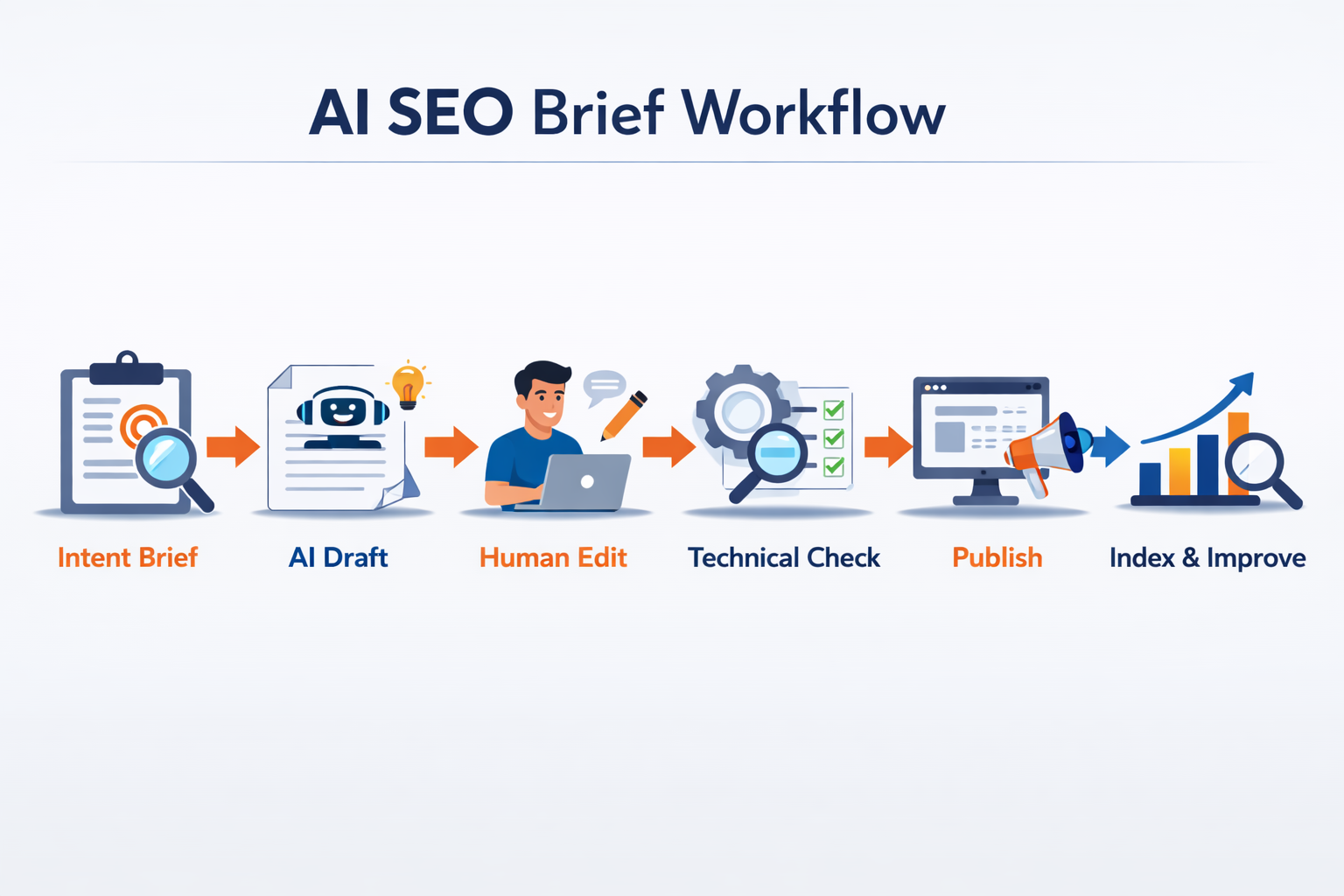
- Step 1: define one primary intent and one conversion action
- Step 2: list 5 to 10 real user questions around that intent
- Step 3: map section order to decision flow (problem -> proof -> action)
- Step 4: generate draft headings and FAQs with AI
- Step 5: enrich with examples, proof, and internal links
- Step 6: publish and submit sitemap for crawl discovery
Common indexing blockers to catch early
Some pages are fully crawlable and still do not get indexed. This usually means weak quality signals or mixed technical signals.
You can avoid most of this by running a short pre-publish checklist that includes both technical and editorial checks.
- Near-duplicate pages with only surface-level copy changes
- Canonical conflicts between similar URLs
- Thin pages that do not answer the search intent deeply enough
- Weak internal links from stronger pages on your site
- Slow mobile experience and unstable layout shifts
Technical checks before every publish
Even strong copy underperforms when technical basics are inconsistent. Run a final gate before every release.
This takes a few minutes and saves days of confusion later when teams wonder why a page is not appearing in search.
- Canonical URL is present and correct
- Page is indexable (no accidental noindex)
- Robots and sitemap endpoints are reachable
- Core Web Vitals are acceptable on mobile
- Internal links point to relevant supporting pages
- Structured data is valid when applicable
What to measure after publishing
Impressions alone can hide real problems. Track indexing speed and conversion quality together.
Also track indexing lag by template. Over time you will see which structures get discovered quickly and which ones need rework.
This gives your team a real feedback loop instead of one-off troubleshooting.
- Discovery: URL appears in sitemap and is crawlable
- Indexation: page gets indexed within expected window
- Visibility: impressions and queries match intended topic
- Engagement: bounce and scroll indicate message fit
- Conversion: CTA quality, not only volume
Useful outbound resources for your team
Keep these links in your editorial SOP so new team members can follow the same standards without guesswork.
They are also useful when you need to settle internal debates with official guidance instead of opinions.
- Google Search Console documentation for indexing and coverage
- Google PageSpeed Insights for mobile performance checks
- Schema.org reference for structured data implementation
From brief to published page in Bizabee
Bizabee helps teams shorten the messy middle between strategy and publish. You can draft quickly, refine intent and CTA copy, and keep each page tied to one business outcome.
The best setup is hybrid: AI handles the heavy drafting, your team owns final judgment.
That is usually where results improve, not just output volume.
- Create each page from one intent-led brief
- Refine copy and CTA around real decision stages
- Publish, then review crawl and conversion signals weekly
More technical references
- https: //pagespeed.web.dev/
- https: //schema.org/
- https: //developers.google.com/search/docs/crawling-indexing/sitemaps/overview
About the author
Yarden Gabay is the founder of Bizabee, an AI marketing platform for small teams. He writes about lead generation, landing pages, and the marketing systems that help small businesses grow without big budgets.