
The organic promotion routine: what to do every day, week, and month
A working routine for organic growth: which channels to run, what to do daily, weekly, and monthly, and how to win SEO and AI visibility without ad spend.
What organic promotion actually is
Organic promotion is visibility that compounds without a media budget: search results, AI assistant answers, social feeds, reviews, email lists, and communities.
Paid traffic is rented. The moment you stop paying, the leads stop. Organic visibility works differently: a review you earned last year still ranks, a page you wrote still answers a buyer's question, and a profile you maintained still shows up locally.
That difference changes how you should spend time. Paid channels reward budget. Organic channels reward consistency, and consistency is a schedule problem, not a talent problem.
This article gives you the schedule. It covers which channels to run, what to do every day, every week, and every month, and how the two fastest-moving surfaces - Google search and AI assistant answers - fit into the routine.
- Local search: your Google Business Profile and how you rank for nearby buyers
- AI answers: what assistants like ChatGPT, Gemini, and Perplexity say when a buyer asks who to hire
- Social feeds: the one or two platforms where your buyers actually spend time
- Owned attention: your email list and past customers, who cost nothing to reach again
Pick channels you can sustain (the 4-hour test)
Before any routine, make one honest decision: how many hours per week can you actually give this? Not in a motivated week - in a normal week with client work, operations, and life.
Then run two to four channels maximum. A channel you cannot sustain for 90 days is worse than no channel: it creates publish-pause-publish cycles that the algorithms and your audience both read as unreliability.
One rule binds every channel together: each one must point at a capture destination. A lead page, a booking page, or a contact page with a form. Traffic without a place to convert is just noise with a like counter.
- Google Business Profile: the highest-leverage channel for any local business. Posts, photos, review replies, and updated hours directly affect local ranking
- Blog/SEO: slowest to pay off, longest payoff. Own the questions your buyers type and ask AI assistants
- LinkedIn or Facebook: pick the platform where your buyers are, not the one you enjoy most
- Reviews and reputation: not a publishing channel, but a ranking and trust channel that runs on requests
- Email: converts attention you already have; every other channel exists partly to grow it
- Communities (Reddit, Quora, local groups): buyers literally asking for recommendations - answer them
- Video (YouTube, Reels, TikTok): only if you can film; one video channel done weekly beats three done never
AI visibility: how to be the brand assistants recommend
A growing share of buyers now skip the search box. They ask an AI assistant: "who is the best accountant for freelancers in Austin?" If the assistant does not know your business exists, you lose that buyer before the buying journey officially starts.
AI assistants build answers from the same public web as search engines, but they weight different things: clear, crawlable statements of what you do, who you serve, and where; directories and comparison lists they can cite; and reviews written in the customer's own words.
None of this requires tricks. It requires that your basic facts are stated plainly, in public, in more than one place.
Then track it monthly: write five questions a real buyer would ask an AI assistant when looking for what you sell, run them, and record whether you are mentioned, whether competitors are mentioned instead, and which sources the assistant cites.
Example probes for a local service business: "best plumber in Leeds for emergency callouts", "who do you recommend for boiler installation near me", "top rated dentists in Scottsdale with good reviews", "is [your brand] good for home renovation", "what do customers say about [your brand]".
You are looking for a trend, not a score. Getting mentioned at all is stage one. Getting mentioned in position one is stage two. Watching which sources the assistant pulls from tells you exactly which directory, list, or review site to invest in next month.
The five moves, in order of impact:
- State the full sentence on your website: what you do, for whom, in which city. Make it easy for a machine to quote you
- Get listed where assistants look for corroboration: industry directories, local business lists, chamber of commerce pages, comparison articles
- Collect reviews that name the service: "she handled my VAT registration" teaches the model what you do; "great service" teaches it nothing
- Publish FAQ pages that answer real buyer questions verbatim - assistants quote answers, not slogans
- Keep your Google Business Profile complete and current: it is a primary local source for both Google and AI answers
SEO that still works (and what stopped working)
SEO earned its reputation for being slow because most people do it backwards: they write everything they can think of, wait, and hope. The version that works is narrower.
What stopped working: mass-produced thin posts, city pages that are the same text with the place name swapped, and keyword stuffing. Search engines and AI assistants both now recognize when a page was written to rank rather than to help, and both respond the same way - by not showing it.
Against that backdrop, here is what still works - and remember the bar: one page that fully answers one question is worth more than five shallow ones. If you can only sustain one page a week, that is a real organic strategy.
- One page answers one buyer question completely. A page that tries to answer ten questions ranks for none
- Local intent pages beat generic ones: "emergency electrician Bristol" on its own page, with its own proof, beats a homepage trying to cover every service and every city
- Refresh content you already rank for before you write anything new. Updating a page that sits on the second page of results usually returns more than a new article
- Internal links: every new page should link to your capture page and to two or three related pages. Orphaned pages do not rank
- Fast pages win: images compressed, no bloated scripts, mobile first. Buyers abandon slow pages before the algorithm even counts the visit
The daily routine: 15 minutes
Daily work is about responsiveness, not production. Everything here is small enough to do before the first coffee gets cold.
Fifteen minutes a day beats a five-hour Sunday session. Daily presence keeps response times low, and low response times are visible to buyers and algorithms alike. If you are the owner, this slot belongs in the calendar like any meeting.
- 1) Reply to every message, comment, and mention. Speed to lead is the single biggest organic conversion factor - a lead contacted within an hour converts several times better than one contacted the next day
- 2) One engagement action on your priority channel: a thoughtful comment on someone else's post, not just your own broadcast
- 3) Check today's plan and do the one task that is due, so the system never builds a backlog
- 4) Log one thing learned: which post got replies, which question came up twice, which objection keeps appearing
The weekly routine: about two hours
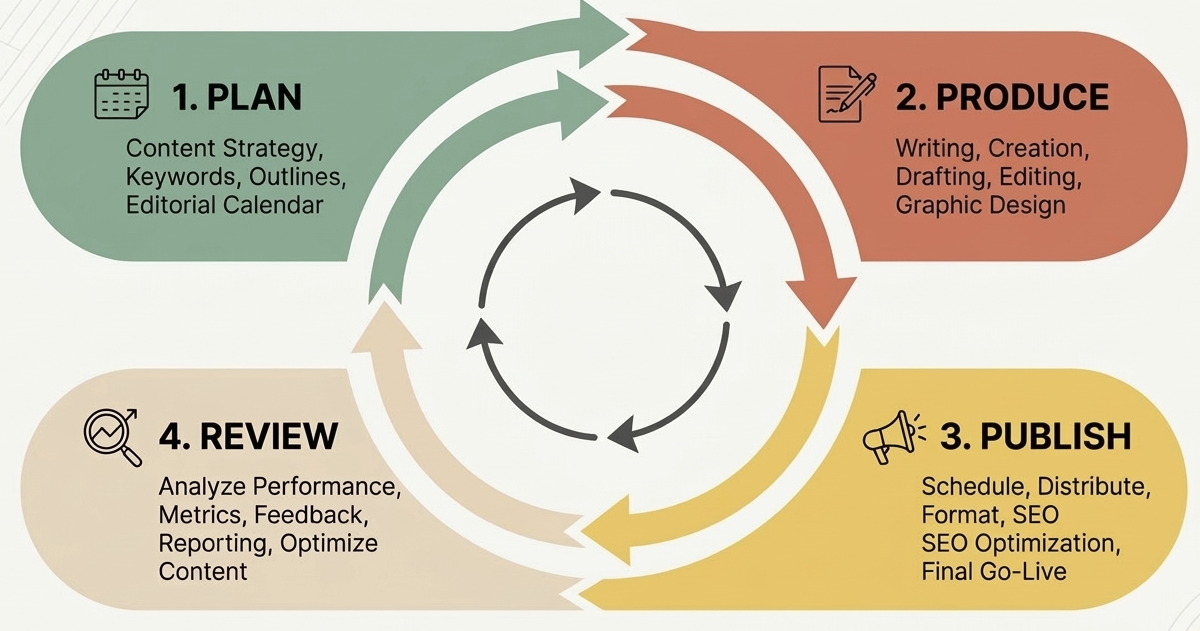
Weekly work is where content gets made. The core model is one base asset, several doors: produce one substantial piece, then distribute it across the channels you chose.
Run it in this order, and give the last item its due: the Friday decision matters more than the publishing itself. Teams that never review keep feeding channels that have not produced a single lead in six months, and starve channels that work. Double, keep, pause - three words per channel, no committee.
- Publish one core piece: a blog post answering one buyer question, or one video, or one long-form post. One, not five
- Repurpose it into three to five touchpoints: a LinkedIn post, a Google Business Profile update, an email, a community answer. Same idea, channel-native wording
- Ask one happy customer for a review. Direct, personal ask, with a link that opens the review form in one click
- Post once on your Google Business Profile: an offer, a photo from a job, an update. Local ranking rewards an active profile
- One outreach touch: email or message a potential partner, propose a collaboration, or answer a question in a community thread where your expertise is relevant
- Friday, 15 minutes: review the week. Leads, replies, review requests sent, what shipped. Per channel, write one decision: double, keep, or pause
The monthly routine: half a day
The monthly session is also where you connect the two loops: the content loop (what we published) and the business loop (what we sold). If a channel ships every week but never produces a lead, the fix is either the message, the capture page, or the channel - and half a day of monthly review is where you figure out which.
- Run the five AI-probe questions from section 3 and record the trend: mentioned or not, in what position, citing which sources
- Refresh one existing page or post: update facts, add a paragraph answering a question buyers asked this month, improve the headline if the page gets impressions but no clicks
- Read the channel numbers honestly: leads per channel, not likes. Which channel produced an email or a call this month?
- Prune: pause the weakest channel and move its hours to the strongest. Sustaining four channels at 25% beats sustaining six at 10%
- Update your positioning notes if anything changed - new offer, new audience, new service area. Every channel downstream uses these words
Measure what compounds
Organic metrics lie to you in different ways than paid ones. A viral post with zero leads is a compliment, not a result. Track these instead. Everything else - impressions, followers, reach - is diagnostic: useful for understanding, useless for deciding whether organic is working.
- Qualified leads per channel: people who reached out, not people who looked
- Review count and velocity: are new reviews arriving monthly? Stalled review pages read as dead businesses
- Branded search volume: do people type your name? It grows only when the whole routine works
- Direct traffic and repeat visitors: the compounding part of organic
- Reply rate on outreach and community answers: are your messages relevant?
- AI mentions: position and sources from your monthly probe check
Common failure patterns
- Starting six channels at once and abandoning all of them by week six. Two channels for 90 days outranks six channels for 20 days
- Publishing without a capture destination. Great post, but where does the interested reader go?
- Copying competitors' content instead of answering your buyers' actual questions. You end up invisible in a conversation you were winning
- Ignoring reviews until there is nothing to show. One review request per week, every week, forever
- Skipping the weekly review. Months pass on a channel that never produced a lead
- Quitting SEO at week eight. Local search and AI answers reward the businesses still publishing in month six, which is exactly why so few are
Your first 30 days
Week 1: set up or fix the foundation - complete Google Business Profile, one capture page with a working form, and pick three channels you can sustain. Write your five AI-probe questions and record today's baseline.
Week 2: publish your first core piece and repurpose it into three channel touchpoints. Send your first review request.
Week 3: first outreach touch (partner, collab, or community answer) and continue the daily 15 minutes.
Week 4: run your fourth weekly review, check the AI probes against baseline, and make your first double/keep/pause decisions.
Thirty days does not produce a lead machine. It produces a functioning system - and month two improves the inputs, month three the results.
Run this routine on autopilot
Every piece of this routine - the daily task check, the weekly publish-and-review loop, the review requests, the community answers, the channel double/keep/pause decisions, the AI visibility probes - is what Bizabee's Growth engine runs for you.
The engine plans your week across channels, drafts the content in your brand voice, asks for approval in one click, publishes or hands off where it can, and runs the Friday review with you. You make the decisions; the legwork is done.
If you would rather execute the routine yourself, this article is the checklist. If you would rather have the routine executed, that is the product.
About the author
Yarden Gabay is the founder of Bizabee, an AI marketing platform for small teams. He writes about lead generation, landing pages, and the marketing systems that help small businesses grow without big budgets.