
Build a marketing engine for small teams
A complete operating playbook for small teams that need consistent marketing output, measurable growth, and less execution chaos.
Why most small teams lose momentum
The issue is rarely ideas. The issue is execution architecture.
Small teams usually do not fail because they lack creativity. They fail because their work depends on energy spikes, not systems. One week they publish heavily, the next week nothing ships. That stop-start rhythm hurts reach, trust, and team morale.
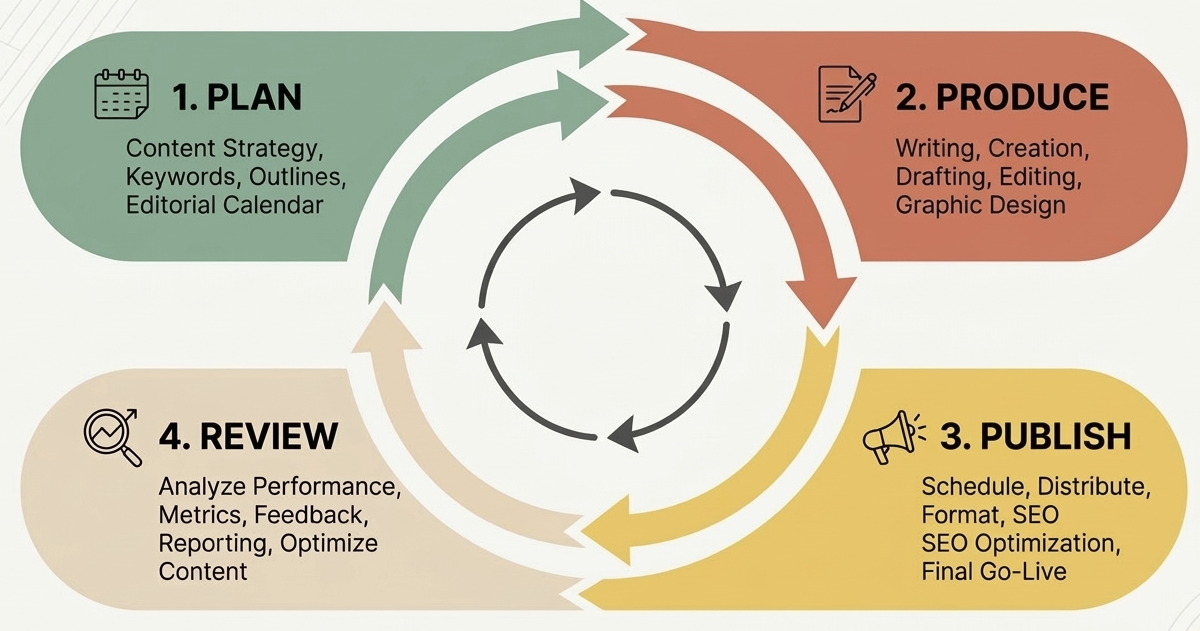
A marketing engine gives your team a predictable rhythm for planning, producing, publishing, and learning. It removes randomness from execution so results can compound over time.
When output depends on motivation, performance is unstable. When output depends on process, every week becomes a data point you can improve. This is the difference between hoping for growth and operating for growth.
A system beats inspiration when deadlines are real.
Define the minimum viable engine first
Before adding channels or campaigns, define the minimum engine your team can run every week without burnout. If your baseline system is too heavy, it will collapse during busy periods.
A good minimum engine answers four questions clearly: who are we targeting this week, what problem are we addressing, what do we want the audience to do next, and how will we measure if it worked.
Do not optimize for perfect coverage. Optimize for sustainable consistency. Small teams win by shipping focused work every week, not by planning massive campaigns they cannot maintain.
- One audience segment per week
- One core message tied to one painful problem
- One conversion action (book, sign up, request, or buy)
- One KPI set reviewed on the same day each week
The 4-block weekly engine that works in practice
Most teams try to optimize all four blocks simultaneously. That creates noise and hides what is actually improving performance. Instead, keep three blocks stable and iterate one.
For example, if you are testing a new headline structure, keep your audience segment, channel mix, and CTA constant for that cycle. You need controlled conditions to learn what worked.
Over 8-12 weeks, this approach creates a practical knowledge base: which offers convert, which proof blocks improve response, and which publishing times produce better quality leads.
- Plan: one audience, one pain, one offer
- Produce: 3-5 assets from one narrative spine
- Publish: fixed cadence and one dominant CTA
- Review: one data-backed change carried into next week
Assign roles so work does not stall
In small teams, one person often handles too much. That is normal, but role clarity still matters. If responsibility is vague, approval loops become slow and publishing slips.
You do not need a large org chart. You only need clear ownership for decisions that block execution.
In very small teams, one person can hold multiple roles, but each role still needs a clear weekly output. Shared ownership without clear deliverables usually creates delays.
- Planner: owns weekly audience, message, and KPI target
- Producer: creates assets and keeps quality consistent
- Publisher: schedules and launches on time
- Analyst: reviews results and proposes one next experiment
Build your content and landing page together
One of the biggest performance leaks is disconnect between content and destination page. Posts promise one thing, landing pages say another, and conversion drops.
Treat your weekly content set and landing page as one journey. Every asset should reinforce the same offer, same problem framing, and same next action.
If your team publishes content without a conversion-ready destination, you are buying attention without capturing value.
- Use one message angle across content and landing page hero
- Repeat the same promise language in CTA labels
- Add proof near CTA to reduce hesitation
- Track click and submit events from day one
How Bizabee shortens execution cycles
Instead of bouncing between docs, design tools, and ad managers, Bizabee helps your team generate campaign assets and landing pages from one strategic input.
That means less context switching, fewer interpretation errors, and faster time from idea to publish. In small teams, cutting coordination overhead is often the highest-leverage improvement.
Use Bizabee to standardize structure while keeping your brand voice and offer logic clear. The goal is not just faster output. The goal is reliable output that converts.
A practical operating rhythm is: generate ideas and variants in Discover, save the strongest assets, then schedule from Publish so execution stays tied to one campaign spine.
Hard scenario: everyone is busy but growth is flat
This is the most common small-team pain: high effort, low compounding results. Usually the issue is too many disconnected priorities running at the same time.
The fix is operational focus. Run fewer campaigns, with tighter message continuity and stronger weekly review discipline.
- Pause low-confidence experiments that do not support the weekly core offer
- Map every published asset to one conversion path and destination page
- Require one clear hypothesis before each weekly publish cycle
- Keep one documented learning after each weekly review
The decision loop that compounds performance
A strong engine is not just publishing cadence. It is decision cadence. Teams that improve fastest decide quickly, test clearly, and document what changed.
Use a simple loop: decide one message shift, ship it across assets, measure conversion quality, then keep or replace the shift next week.
- Decision input: one bottleneck from last week (message, offer, or CTA)
- Execution: apply one focused change across this week assets
- Measurement: compare qualified actions, not only traffic volume
- Outcome: keep what improved signal quality and drop what did not
Metrics that keep a small team honest
Many teams track only top-of-funnel numbers such as impressions or likes. Those metrics are useful, but they do not tell you if marketing is driving business outcomes.
Use a compact metric stack that connects visibility to conversion quality. Keep it simple enough to review weekly and clear enough to drive decisions.
- Output metrics: assets shipped, publish consistency, cycle time
- Traffic metrics: qualified sessions, source mix, click-through rate
- Conversion metrics: CTA clicks, form submit rate, lead quality
- Learning metrics: experiment velocity and win rate
Common failure patterns and quick fixes
If your engine is running but results are flat, the issue is usually not effort. It is usually one structural mismatch in message, offer, or conversion flow.
- Problem: high reach, low conversion. Fix: tighten message-to-offer match.
- Problem: good clicks, poor form submits. Fix: improve trust block and reduce form friction.
- Problem: inconsistent output. Fix: lower weekly scope and protect publish deadlines.
- Problem: busy team, no learning. Fix: force one weekly review and one next experiment.
30-day implementation for real teams
Use the first month to build reliability, not complexity. A stable operating rhythm in month one gives you leverage for better experimentation in month two.
- Week 1: baseline current output, traffic quality, and conversion performance
- Week 2: lock a realistic publish cadence and assign clear owners
- Week 3: align all assets to one conversion path and one landing page
- Week 4: review data, keep winners, and document the operating playbook
What this looks like after 90 days
After three months of disciplined execution, most small teams see clearer messaging, faster cycle times, and more consistent lead flow. They also gain confidence because decisions are no longer based on guesswork.
You do not need a perfect strategy document to get there. You need a weekly operating system your team can run under real constraints.
Build the engine first. Then scale channels, budget, and experimentation from a stable foundation.
About the author
Yarden Gabay is the founder of Bizabee, an AI marketing platform for small teams. He writes about lead generation, landing pages, and the marketing systems that help small businesses grow without big budgets.