
From one idea to a weekly content calendar
A practical one-day system to turn a single idea into a structured weekly calendar that drives qualified traffic and conversions.
Why content calendars fail in real teams
Most calendars fail because they are publishing lists, not strategy maps.
Most teams have no shortage of content ideas. The real problem is fragmentation. One post is educational, the next is promotional, the next follows a trend, and none of them build toward one business outcome.
A calendar without strategic continuity creates activity but not momentum. You might publish often, yet the audience does not clearly understand your offer or why they should take action now.
A strong weekly calendar starts from one campaign intent and one audience problem. Every asset in that week should reinforce that core message from a different angle.
Start with one campaign spine, not many disconnected topics
Before drafting content, write one campaign spine sentence: who the audience is, what problem they are experiencing, what result they want, and what action you want them to take.
This sentence becomes your decision filter. If a post idea does not strengthen that campaign spine, it does not belong in this week.
This is how small teams remove decision fatigue. You stop debating every post and start building connected assets with clear intent.
- Audience: one segment, not everyone
- Pain: one urgent problem, not a broad topic
- Promise: one practical outcome
- Action: one conversion goal for the week
Build a one-day content sprint that is actually sustainable
The one-day sprint works because it creates batches. Batching reduces context switching and protects quality. You are not rewriting strategy every day.
Your output should include at least one awareness asset, one credibility asset, and one conversion asset. That mix creates a natural buyer journey across the week.
If your team is very small, keep the first sprint constrained. One week, one audience segment, one offer. Complexity is usually what breaks consistency in month one.
- Hour 1: define audience pain, campaign promise, and one conversion goal
- Hour 2: generate 8-10 hooks and select the strongest 3 by intent clarity
- Hour 3: create short, medium, and long variants from the same narrative
- Hour 4: map publish sequence, CTA links, and tracking parameters
Use a weekly sequence instead of random publishing
A good weekly content calendar is a sequence, not a bucket. Each post should prepare the audience for the next stage of trust and decision readiness.
When posts are sequenced well, conversion rates improve because users do not feel like they are being sold too early. They feel guided.
This also improves creative quality. Instead of forcing every post to do everything, each asset has one role in the buyer journey.
- Day 1: problem framing that qualifies the right audience
- Day 2: practical method or framework that shows competence
- Day 3: proof story, case evidence, or before/after clarity
- Day 4: objection handling and risk reduction
- Day 5: CTA post that offers one clear next step
Make each post drive one business action
Use informational posts to earn attention, proof posts to build trust, and CTA posts to convert that trust into action. Mixing all intents in one post usually weakens performance.
Every post should have one expected behavior: click, save, reply, book, subscribe, or request. If the expected behavior is unclear, results become hard to improve.
A useful rule is one post, one behavioral ask. If you ask for too many actions, users choose none.
- Awareness post CTA: learn more
- Proof post CTA: see process or result breakdown
- Decision post CTA: take one concrete action now
How to keep calendar quality high with a small team
Quality drops when teams rush into publishing without clear review checkpoints. You do not need a heavy approval process, but you do need three simple checks before anything goes live.
- Message check: does this post reinforce the weekly campaign spine?
- Clarity check: can a new user understand this in under 5 seconds?
- Action check: is there one clear next step tied to business value?
Hard scenario: calendar is full but pipeline is empty
This happens when your calendar optimizes for consistency but not buyer intent. You are publishing, but not moving qualified prospects toward a decision.
The fastest fix is not more content volume. It is message precision and better post-to-destination continuity.
- Check if high-performing posts are attracting the wrong audience segment
- Check if CTA promises match the landing page headline and offer
- Check if proof posts include concrete outcomes, not generic testimonials
- Replace one low-intent post with one objection-handling post each week
Connect planning to execution in Bizabee
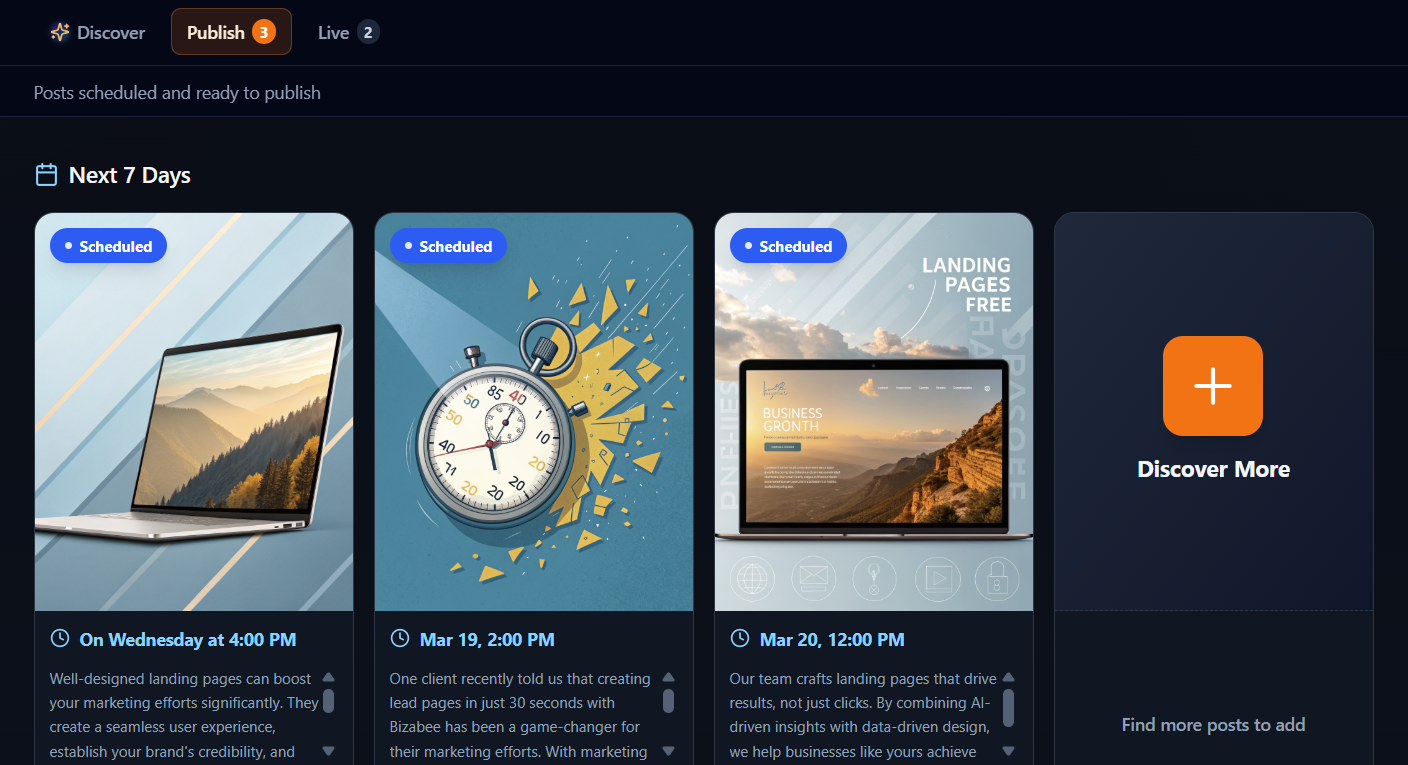
The system works best when planning and execution live in the same workflow. In Bizabee, teams can generate concepts, refine assets, and queue publishing without switching tools.
Use one campaign spine in Discover, save only qualified assets, then move to Publish for schedule control. That keeps the weekly sequence intact under real workload pressure.
- Generate variants in Discover from one core campaign intent
- Refine hooks, CTA language, and visuals before saving
- Move selected assets to Publish and schedule in sequence
- Review results weekly, then feed learnings into next sprint prompts
Track performance weekly, not randomly
A calendar is only valuable if it teaches your team what to improve next week. Review the same metrics on the same day every week so learning compounds.
Do not optimize for vanity metrics alone. Likes can rise while lead quality drops.
- Top-of-funnel: reach, profile visits, CTR
- Mid-funnel: page engagement, scroll depth, return visits
- Bottom-funnel: CTA clicks, form submits, qualified leads
Use Bizabee to build and run the calendar faster
With Bizabee, you can generate a full weekly flow from one campaign intent, keep CTA consistency across assets, and move from planning to publish without tool sprawl.
This helps small teams protect consistency and ship on time, especially when one person is handling multiple responsibilities.
30-day rollout you can start this week
After one month, you should not just have more content. You should have a repeatable calendar system that your team can run reliably and improve every week.
- Week 1: define your campaign spine and publish first structured sequence
- Week 2: improve hooks and tighten message clarity
- Week 3: strengthen proof assets and objection handling
- Week 4: optimize CTA language and conversion flow
About the author
Yarden Gabay is the founder of Bizabee, an AI marketing platform for small teams. He writes about lead generation, landing pages, and the marketing systems that help small businesses grow without big budgets.